

When a child is diagnosed with cancer, the focus immediately goes to treatment. The oncologist, the chemotherapy protocol, the hospital. All of that is right and necessary. But there’s a factor that shapes how well treatment works, how much of it a child can tolerate, and whether they make it through to the other side; and it still doesn’t get enough attention.
That factor is nutrition.
Clinical evidence increasingly shows that nutrition directly affects treatment outcomes in paediatric cancer. According to the National Cancer Institute and the American Society of Clinical Oncology, children who are malnourished are more likely to experience treatment toxicity, interruptions, infections, and lower overall survival rates. In contrast, well-nourished children are better able to tolerate intensive therapy and complete treatment protocols.
The Starting Point: Malnutrition at Diagnosis
Around 58% of children with cancer in India are already malnourished when they’re first diagnosed. This isn’t because their families don’t care. It’s because cancer itself suppresses appetite, because many families come from low-income backgrounds where food security is already fragile, and because the journey to diagnosis is often long and exhausting.
By the time a child begins treatment, their body may already be depleted. And then chemotherapy makes eating even harder. Nausea, mouth sores, fatigue, and taste changes all reduce intake at precisely the moment the body needs more.
Dr. Nita Radhakrishnan, Additional Professor and Head of Department at PGICH Hospital, Noida, sees this every day. Many children who come in are already nutritionally vulnerable, she explains, and chemotherapy, infections, and treatment make their needs even greater. For her team, ensuring access to good quality, adequate food is as important as providing chemotherapy, antibiotics, and other life-saving therapies. Regular nutritional monitoring and early support are not optional. They are essential pillars of cancer care.
Without intervention, the result is a downward spiral: undernutrition weakens the child, treatment becomes harder to tolerate, complications increase, treatment delays stack up, and outcomes worsen.
What Happens When Nutrition Is Addressed
The good news is that this spiral can be interrupted and the outcomes are striking.
Global guidelines from the International Society of Pediatric Oncology emphasise that early and continuous nutritional support is a key component of improving survival rates in low- and middle-income countries, where treatment abandonment and complications remain major challenges.
Cuddles Foundation’s 2025-26 Impact Report shows that undernourishment dropped by 25% between when children entered the FoodHeals Program and when they completed treatment. Among new patients, 58% were undernourished on arrival. By the end of treatment, that figure had fallen to 33%, while the proportion of well-nourished children rose from 38% to 54%. Children are getting healthier as they heal because nutrition and medicine are working together.
81% of patients improved or maintained their nutritional status despite undergoing chemotherapy or radiation. In a context where the body is under extraordinary stress due to the often harsh treatment regimens, that is a significant clinical achievement.
A survey of 1,327 caregivers across multiple hospital sites adds a human dimension to these numbers.
- 95% reported improvement in their child’s weight and nutritional status.
- 93% saw improvement in strength and mobility.
- And every single caregiver — 100% — rated nutrition support as important to their child’s care. One parent put it plainly: “Without this program, my child would not have regained strength or weight so quickly.”
The Return on Investing in Nutrition
For CSR donors and organisations thinking about where their contribution can do the most good, there’s a figure from an independent assessment by Crisil Intelligence that’s worth knowing: for every rupee invested in the FoodHeals Program, ₹2.63 worth of social value is generated. Families also saw a 31% reduction in out-of-pocket nutrition costs after joining the programme. Critical relief for households earning under ₹20,000 a month, where every rupee saved on food is a rupee that can go toward treatment.
A Child Cancer Nutrition Plan: What It Actually Involves
A good child cancer nutrition plan isn’t a printed handout. It’s a living, monitored protocol that adapts as the child’s condition changes.
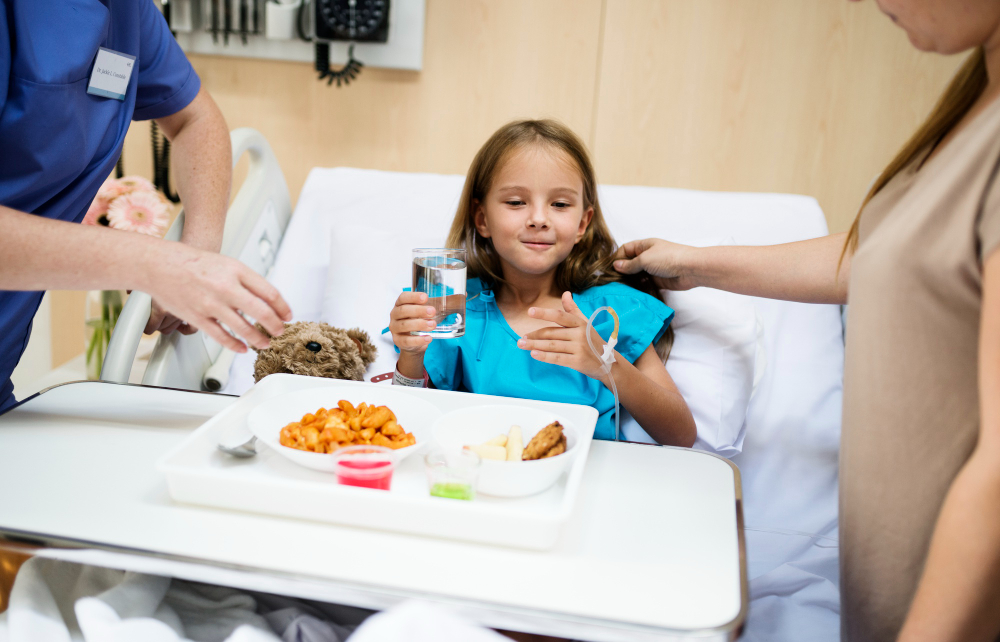
At Cuddles Foundation, that means assessing each child’s nutritional status when they first arrive at a partner hospital, then building a plan that accounts for their specific treatment protocol and its side effects. It means providing specific nutritional supplements for the children, in-meals at the hospital, and ration bundles for the child and families at home — so that the child’s nutrition doesn’t collapse between visits. And it means continuously monitoring and adjusting, so that if a child’s status deteriorates, the plan is updated before it becomes a crisis.
In 2025-26, this translated to 69,000 nutritional supplements, 85,000 hot meals, and 1,543,000 in-meals distributed — across a program serving over 20,270 children at 48 hospitals in 17 states.
The Connection to Treatment Completion
One of the most concrete ways nutrition improves cancer treatment outcomes in children is through treatment adherence. When nutrition is consistently part of a child’s care, 96% follow through on their treatment plan; returning for their next visit and continuing their protocol.
Treatment delays are one of the leading causes of poor outcomes in paediatric cancer. When a child is too weak to receive their next cycle of chemotherapy, or develops an infection, or simply can’t tolerate what’s being administered, the disease gains ground. Consistent nutrition support reduces all of those risks.
Jyoti, whose son Shaurya was guided to Cuddles Foundation by his treating doctor, knows what that consistency meant for her family. “They told us what to feed him, what was good for his body, and provided him with protein supplements, monthly rations, and the right support to help him grow stronger,” she said. “For the first time, I felt like someone was truly guiding us. Knowing my son is getting the right nutrition every day gives me the strength to keep going.”
The Impact Doesn’t Stop at the Hospital Gates
One of the findings from the 2025-26 Impact Report that deserves more attention: 77% of the children supported through FoodHeals went back to school after completing cancer treatment. That’s not just a survival statistic: It’s a full-life statistic. These children didn’t just get through treatment. They went back to their classrooms, their friends, their futures.
83% of caregivers continued the nutrition practices introduced during the programme even after support ended, and 85% felt better equipped to manage their child’s nutritional needs. The learning stays with families, which means the impact compounds and continues long after the programme formally closes.
Finding the Right NGO for Cancer Children
For families navigating this, and for donors wanting to help, the right NGO for cancer children is one that considers nutrition as part of the treatment protocol,not a separate charitable function. Cancer NGOs in Mumbai like Cuddles Foundation work inside hospitals, alongside medical teams, as part of the care. That integration — and the independent verification of its impact — is what makes the difference between nutritional support that genuinely changes outcomes and support that remains largely symbolic.
Food and Nutrition, Together
The importance of nutrition in paediatric cancer is no longer theoretical; it’s documented, measured, independently verified, and real. Children who are well-nourished tolerate treatment better, complete more of it, experience fewer complications, recover stronger, and go back to their lives.
Every donation to Cuddles Foundation’s FoodHeals Program is an investment in those outcomes.
Not in hope alone — in evidence. #FoodHeals
Help more children fight cancer with food on their side. Donate today.